
Group Project: Our team of 5 researched and redesigned a standard front door lock over 6 weeks, using a survey, observations, a heuristic evaluation and a 3D printed prototype.
Role: 3D modeling, rendering and printing the prototype; creating the persona and project roadmap and submitting the team’s deliverables. Collaborated with the team on the survey, heuristic evaluation and analysis.
Team: Group of 5, class project
Timeline: 6 weeks
Tools & Skills: Figma, Autodesk Fusion, Canva, QuestionPro, 3D Printing & Modeling, User Research, Heuristic Evaluation, Personas, Prototyping
The problem
How can a standard front door lock be easier to use and easier to trust?
Our team chose a product to improve: a standard, non-digital front door lock. It had to be something we all had access to, because we had to do our research remotely. Over 6 weeks, we used industry-standard research methods to find the problems and design an improved product to be tested.
Who It's For
A persona, Sarah: Sarah is a fictional person based on the survey findings. She is a 23-year-old student who frequents late-night outings. She uses her door about 4 to 5 times per day, carries many items in her hands and keeps her keys in her purse because of this. She cares about feeling safe and secure because she lives alone and thinks about alternatives to a key, like a fob.

There were other personas that were considered that other teammates created for this project.
Below are my observation and notes:
Our team watched 3 different people use a lock, noting time-on-task, challenges and comments.
Participant 2: [Personal information redacted]
Time to unlock: ~10 seconds
Challenges I Observed:
Difficulty locating the keyhole; the key was dragged across the faceplate and scratched before being inserted.
When turning the key, the wrist was overextended. The movement was perceived as an unnatural movement, leading to a harder and longer locking process.
When the key was turned back to the middle position to pull out, the transition and movement were not smooth. There was some slight resistance to the key when tugged. Observations: The user haphazardly tried to put the key in and did not care about its location. It seemed as if the user was okay “searching” for the keyhole with the key across the faceplate.
User Comment: “See, the only issue I had was finding the keyhole. Everything else is easy.”
Heuristic Evaluation: Our team discussed the findings as a group based on individualized heuristic evaluations of a traditional front door lock. These heuristic evaluations compared the aspects and functionalities of the door lock design/product while ranking them with the original Molich and Nielsen Heuristics (1994), along with the severity rating (on a scale where 1 = Minor, 2 = Moderate, 3 = Major, and 4 = Critical).
Based on the most frequent usability problems and guidelines violated, chose 5 key findings and recommendations. Below is one of my findings and my recommendation.
Finding 3: Users have difficulty turning the key
Violation: Consistency and Standards
Severity: 3
Description: Users expected the lock to turn farther when they inserted the key. This resulted in the user turning the key and twisting their wrist farther than was needed. Some key locks had long turn radii, and some had short—this varying expectation difference confused our users. The users also experienced mild discomfort when turning the key, including wrist and finger strain.

Recommendation 3: The standard lock should have either a specific radius in which the key should turn (standard across all of the locks) and/or have tactile feedback that the lock has been successfully secured by creating a smoother turn for the users with anti-jam technology.
Five Key Findings of the Team:
Finding 1: No indication of whether the front door lock is secured from the outside
Finding 2: Lock does not prevent users from leaving without securing the door
Finding 3: Users have difficulty turning the key
Finding 4: Users have difficulty finding the keyway
Finding 5: Locks look similar, which creates errors of using the wrong key and increased security risk
Ideation
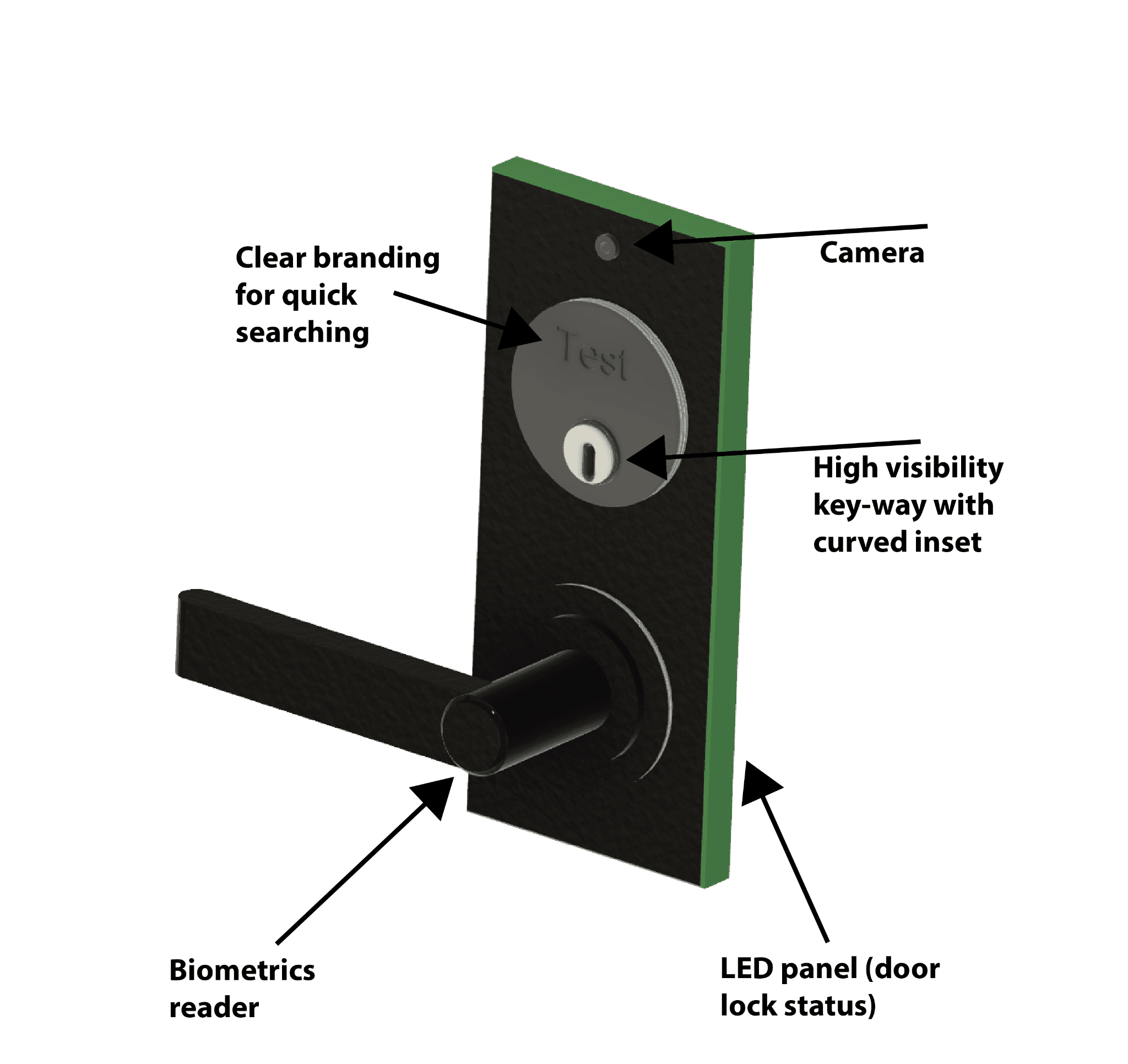
We turned the findings into 2 versions of our prototype based on findings in our research. Our team split off into our separate ways to come up with our own improvements. Our prototype included these design changes:
Visual (LED: Green = unlocked, Red = locked)
Motion-activated LED illumination
High-contrast keyhole design
Wireless recognition system
Key Decisions
These were team decisions. Modeled and printed, but not tested with users at this point.
A status light: green when unlocked, red when locked.
Problem: Users reported not being able to tell if the door was locked from the outside (finding 1), and the lock did not stop you from leaving it unsecured (finding 2).
Adjustment: an LED panel on the lock face would alert the user of the status of the lock. While this would provide a way for users to see a status from the outside, the security risk of people other than the owner seeing the locks status would need to be discussed before implemented.
High contrast keyway with motion activated lighting.
Problem: Users reported having difficulty being able to see the keyway under dark conditions This resulted in many attempts of the key being inserted without success (finding 4).
Adjustment: an LED light that is motion activated when the user walks up to the lock. This would require the power source to continually have this option on the lock. An analog adjustment would be a raised lock face, with a high-visibility curved inset for keys to easily slide into the lock.
Reduce the need for a key with the option for manual if needed.
Problem: Many of the users reported an issue with the key itself. Our findings found that people had a hard time turning keys and even lost the key entirely.
Adjustment: adding a biometric reader on the front of the door lock allows you to unlock the door without a key. As with the light, this would require a way to ensure that the lock had a power source to it continually (this would also address the key jamming issue).
Validation
Testing
Initial observations done, usability test has not been run yet. While the team did not conduct the test, we planned a test to be completed. This test would be aimed at observing whether the changes that have been made to the front door lock have made locking, unlocking and opening the front door easier. We will be focusing on turning the key, pulling out the key and ensuring overall satisfaction of the improvements made on the product in a real-life scenario (such as the one my persona Sarah faces with her hands full)
There will be 3 tasks that will be our focus based on the current gaps our initial research found:
Jamming keys: Having the user walk up to the front door and find their key and successfully unlock the front door without the key getting jammed.
Locking the door with confidence: Have the user recognize that their door has been locked successfully.
Using a keyless system: Have the user be in a scenario with hands full and effectively use the biometric system.
Final design
This is the final rendering of the door lock and the 3D printed version that would be used for testing purposes in the validation and testing stage.


Reflection
What worked
The team addressed some of the most common issues that the users experienced during the initial research in our prototypes. Our survey and observations both showed the key was jamming.
What I would change
This project needed more time for prototyping. Since this project was with a product I am not an expert in, I would need more time to research the inner workings of a lock to understand the nuances of twisting and turning the lock to enhance the product further. One more week of research and modeling would have improved the final product. This also needs a usability test to confirm that our changes were adequate.
What I learned
This project taught me how something as simple as a front door lock, which we use daily, can be cumbersome and difficult for users if not appropriately designed. Observing users uncovered tiny details about affordances I had not previously considered. It shaped me into an even more empathetic designer.